
Smith County Court Records After a Jail Arrest
The arrest-to-court path in Smith County starts when a local officer, deputy, warrant officer, or other agency takes a person into custody and transports the person to the Smith County jail system operated by the Smith County Sheriff's Office under Sheriff Larry R. Smith. Adults arrested by Tyler Police are routed to Smith County Jail, and Lindale Police materials also route arrestees to the Sheriff's Department in Tyler. Jail staff create the booking or jailing record, assign or update identifiers such as the SO number and booking number, and record charge and warrant information supplied at intake.
That first jail entry is not the same thing as the court record. Texas Code of Criminal Procedure article 15.17 requires an arrested person to be taken before a magistrate for warnings, rights, counsel issues, and bail-related processing. After that, the Smith County Criminal District Attorney, led by Jacob Putman, reviews the matter. The DA may accept, reject, amend, reduce, or add charges, and a grand jury may later indict felony charges. For custody and booking details, use jail inmate records. For the booking-photo side of a jailing profile, use jail mugshots. The court record is the filed allegation and case history, not merely the arrest entry.
Arrest, Booking, Magistration, DA Review, and Court Filing
A Smith County jail arrest usually produces several separate records. The jail profile may show the defendant name, SO number, booking number, facility, booking date and time, release date and time when applicable, arresting agency, warrant number, issuing authority, charge description, bond type, and disposition fields. Those fields are useful bridges into court search, especially when several people have similar names.
The formal case route depends on offense level. Felony cases generally move through district courts and the Smith County District Clerk. Misdemeanor cases route through the County Clerk's criminal misdemeanor department. The District Clerk page identifies felony records and district court records as part of that office's work, and the County Clerk criminal misdemeanor materials describe misdemeanor and some felony offense-record support, including warrants, summons, subpoenas, commitments, and related instruments.
The Smith County Criminal District Attorney page identifies Jacob Putman as the DA and lists the office at 100 North Broadway Avenue, 4th Floor, Tyler, TX 75702. The office phone is 903-590-1720, with hours Monday through Friday, 8 am to 5 pm, closed for lunch from 12 pm to 1 pm.
The DA office is the screening point between the jail arrest and the formal prosecution, so the same incident can look different on the jail profile and in the later court case.
How to Find Smith County Court Records After an Arrest
The official Smith County portal at portal.smith-county.com/Public/ offers Smart Search, Search Hearings, and Jail Search. Use the jail profile first when the arrest is recent, then move to Smart Search for filed court records after the prosecutor or clerk creates a case. Arrest and booking detail lives in the jail app; court charge status, hearings, and filed documents belong in the court and clerk systems.
- Open the Smith County jail profile and copy the full name, SO number, booking number, arrest date, arresting agency, warrant number, issuing authority, and charge descriptions.
- Open Smith County Smart Search and search by full name or case number. If the portal supports the identifier for that record, try the SO number or booking number copied from the jail profile.
- Open the matching case and read the filed charge list, offense level, filing date, court location, events, and disposition fields.
- For felony-level matters, check the District Clerk path. For misdemeanor-level matters, check the County Clerk criminal misdemeanor path.
- Use Search Hearings once a case number or party name is known, especially when the question is about the next court date rather than the original booking.
The Smith County Smart Search dashboard is the main case-search route for a name, record number, or identifier tied to the arrest.
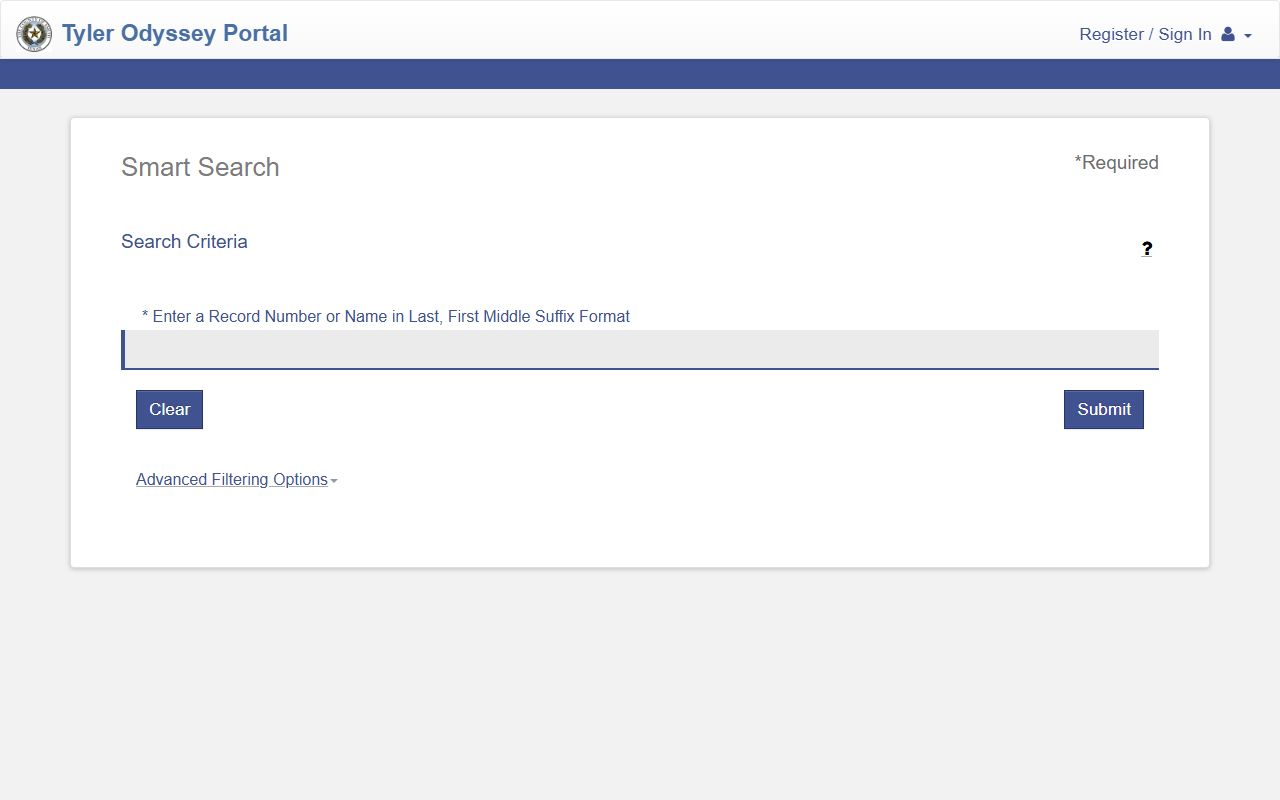
Smart Search is most useful after the case has been filed. If an arrest happened recently and no case appears, the jail record or a call to the jail at 903-590-2800 may be the better first confirmation point.
Smith County Court Case-Search Fields
Smart Search has broader fields than the jail search because it looks across case records rather than only jailing profiles. Name, case number, date, and identifier fields can all matter when connecting a jail arrest to a court record.
| Field Label | Type | Required | Options / Format Notes |
|---|---|---|---|
| Smart Search record number or name | Text | Optional | Search by case or record number, or by party name. |
| Last, First, Middle, Suffix | Text fields | Optional | Party-name fields help separate people with similar names. |
| Location | Dropdown/filter | Optional | Court or location filter visible in advanced search. |
| Search type | Dropdown/filter | Optional | Party name, nickname, business name, or sounds-like options. |
| Include cases/judgments | Checkbox/filter | Optional | Portal option visible in advanced filters. |
| DOB from / DOB to | Date fields | Optional | Date-of-birth range fields may help narrow a person search. |
| Phone number | Text | Optional | Party search field. |
| FBI number | Text | Optional | Identifier search field. |
| SO number | Text | Optional | Useful bridge from the jail profile to court search. |
| Booking number | Text | Optional | Useful bridge from the jail profile to court search. |
| Case type/status | Dropdown/filter | Optional | Narrows criminal, civil, or other case categories and status. |
| File date start/end | Date range | Optional | Narrows by filing date. |
| Judicial officer | Dropdown/filter | Optional | Judge or officer filter. |
| Judgment type/date | Fields | Optional | Judgment filters for later case outcomes. |
Search Hearings for Court Records After an Arrest
After a Smith County arrest becomes a filed case, hearing search can answer a different question from Smart Search: when and where the case is scheduled. The Smith County Search Hearings dashboard supports case-number, party-name, attorney, courtroom, judicial officer, and date-range searches.
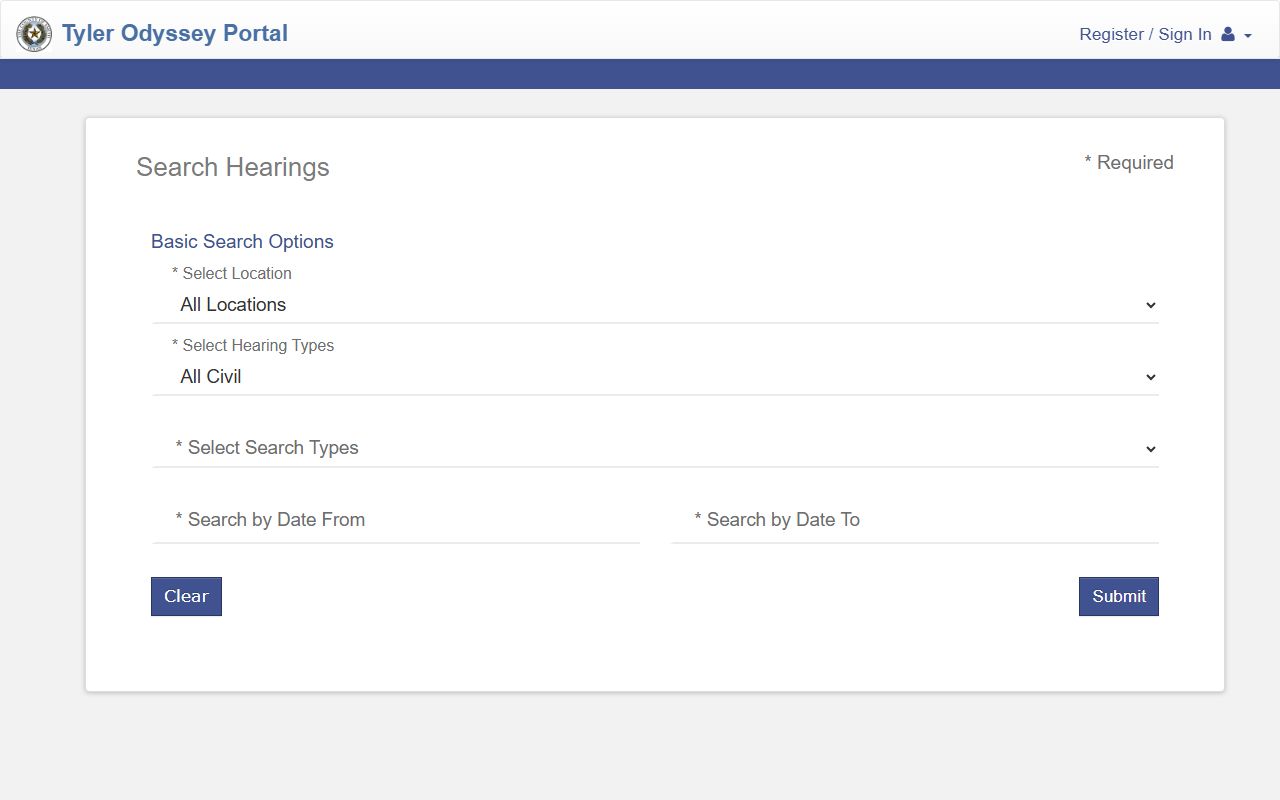
Hearing search is especially helpful once the charge has moved past booking and into court scheduling. A hearing listing should still be checked against the actual case record or clerk office when timing matters.
| Field Label | Type | Required | Options / Format Notes |
|---|---|---|---|
| Location | Dropdown/filter | Optional | Court location. |
| Hearing type | Dropdown/filter | Optional | Includes civil, criminal, family, and probate categories. |
| Case number | Text | Optional | Best route when the case number is known. |
| Party name / business name | Text | Optional | Name search. |
| Attorney name / bar number | Text | Optional | Attorney lookup. |
| Judicial officer | Dropdown/filter | Optional | Judge or officer filter. |
| Courtroom | Dropdown/filter | Optional | Courtroom filter. |
| Sounds-like | Option | Optional | Name variation option. |
| Date from/to | Date range | Optional | Hearing-date range. |
How Charges Get Filed After an Arrest: Complaint, Information, and Indictment
Booking happens at the jail, but the court charge record begins when a charging document reaches the appropriate court. A complaint may start or support a criminal accusation. An information is a prosecutor-filed charging document commonly associated with misdemeanor prosecution and some felony procedure. An indictment is returned by a grand jury and is especially important in felony prosecution. The document type matters because it explains why a jail charge may not match the later court record word for word.
| Document | Who Creates It | Common Use | Why It Matters After Jail Arrest |
|---|---|---|---|
| Complaint | Officer, complainant, or prosecutor-supported filing | Initial accusation or probable-cause support | May appear early and may not be the final filed charge. |
| Information | Prosecutor | Misdemeanors and some felony procedure | Often reflects the DA's screened charge rather than the booking label. |
| Indictment | Grand jury | Felony prosecution | Can add, narrow, or reframe charges after the original arrest. |
Charge Status and What It Means
Charges can change as a case moves from arrest through prosecution. The jail roster charge is the arrest or booking charge. The court charge is the filed allegation. The prosecutor may amend, reduce, add, reject, or dismiss charges, and the court may later record a plea, verdict, dismissal, deferred disposition, or other outcome. A Smith County court record should be read by charge, not only by case caption, because multiple charges in the same case can end differently.
| Status | What It Means |
|---|---|
| Pending | The charge has been filed or is active, and no final disposition is shown. |
| Amended / Reduced | The filed allegation changed after prosecutor review, plea negotiation, or court action. |
| Added | A later court filing or indictment includes a charge not shown on the initial jail profile. |
| Rejected / Not Filed | The arresting-agency charge did not become a filed court charge, or the prosecutor declined that count. |
| Dismissed | The court record shows the charge was terminated without a conviction on that count. |
| Nolle Prosequi | The prosecutor chose not to pursue that charge further, subject to the specific court order and case posture. |
| Convicted / Adjudicated | The record reflects a plea, verdict, or adjudication outcome rather than only an accusation. |
Bond and Release After an Arrest
Bond in Texas is governed by Code of Criminal Procedure Chapter 17, with article 17.15 listing rules for setting bail and article 17.03 covering personal bonds. In Smith County, a jail profile can show a charge-level Bond/Type field, and the inspected sample showed Surety Bond. The public profile does not prove that every record will show a dollar amount, and fine or cost totals are separate from bond. Confirm the amount, conditions, and any release-blocking hold through the jail, court, or clerk record.
| Bond Type | How It Works |
|---|---|
| Cash Bond | The full amount is paid in cash or certified funds through the authorized office. |
| Surety Bond | A licensed bail bond company posts the bond for a fee under Texas surety rules. |
| Personal / PR Bond | The person is released on a promise to appear, sometimes with supervision or conditions. |
| Property Bond | Property is offered as security when accepted by the court. |
| No-Bond Hold | Release is not available through ordinary bond until the hold or court order changes. |
Felony and Misdemeanor Court Records After a Smith County Arrest
For felony matters, use the District Clerk route. The Smith County District Clerk page identifies the office as a source for felony and district court records, as well as writs, warrants, commitments, and other criminal instruments.
A felony case may not be complete at the first arrest listing because prosecutor screening and grand jury action can occur after booking.
Misdemeanor cases route through the County Clerk's criminal misdemeanor department. The Smith County County Clerk page is the starting point for that office.
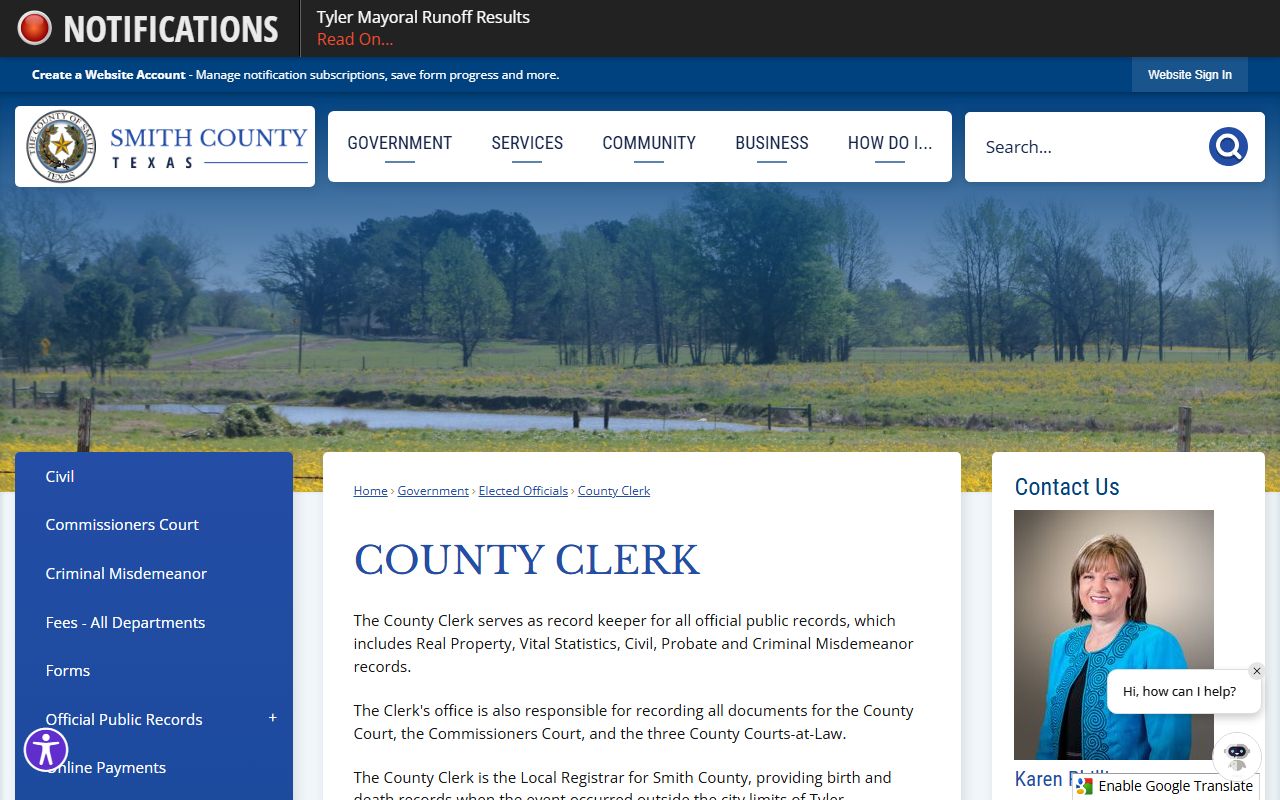
When a jail profile lists only a booking charge, the clerk route helps confirm whether a misdemeanor was actually filed, dismissed, amended, or set for hearing.
Warrants That Lead to an Arrest
No official Smith County active-warrant list or most-wanted search page was located in the reviewed sources. Warrant information can still appear once a warrant results in a booking. The Smith County View Jailing profile includes fields for Warrant # and Issuing Authority, and the District Clerk and County Clerk materials both describe warrant-related court functions. If a warrant has not produced a booking, contact the issuing court or appropriate clerk, and consider legal advice before appearing in person if arrest risk is unclear.
Warrant-connected court records after an arrest may involve an arrest warrant, bench warrant or capias, fugitive hold, or a hold from another jurisdiction. A search warrant is different because it authorizes a search rather than an arrest. Texas does not provide a simple public statewide warrant search comparable to the county jail search.
Charges vs. Convictions
An arrest and a charge are not the same as a conviction. A jail charge reflects an accusation or custody reason at or near booking. A court charge reflects an allegation filed in a case. A conviction requires a plea, verdict, or adjudication outcome recorded by the court. Do not describe a booked person as convicted unless the court record or a sentenced-custody record shows that outcome.
| Charge | Conviction | |
|---|---|---|
| Stage | Accusation after arrest, prosecutor filing, or indictment | Final plea, verdict, or adjudication outcome |
| Proof Standard | May begin with probable cause or a filed allegation | Requires the criminal-case standard for conviction or a valid plea |
| Where It Appears | Jail profile, Smart Search, clerk record, charging document | Disposition, judgment, sentence, or TDCJ record when applicable |
| Can It Change? | Yes, it can be added, amended, reduced, rejected, or dismissed | Changes only through later court action, appeal, post-conviction relief, or record-clearing order |
Sealed vs. Expunged Arrest Records
Texas record clearing is not automatic for every dismissed or old charge. Expunction is governed by Texas Code of Criminal Procedure Chapter 55A. Nondisclosure provisions appear in Government Code Chapter 411, Subchapter E-1. A nondisclosure order limits public access to qualifying criminal-history records, while an expunction is a stronger remedy for qualifying arrest records. Eligibility depends on the disposition, timing, offense type, and court order.
| Nondisclosed / Sealed | Expunged | |
|---|---|---|
| Public Visibility | Limited from ordinary public access when an order applies | Removed or treated as not existing for many legal purposes when granted |
| Government Access | Some agencies may retain authorized access under Texas law | Very limited access, controlled by the expunction order and statute |
| Eligibility | Depends on Chapter 411 nondisclosure rules and the case outcome | Depends on Chapter 55A, including qualifying arrest and disposition rules |
| Practical Effect | The public portal or public response may stop showing the record | Agencies may be ordered to destroy, delete, or return covered records |
Background Check Considerations
A casual court lookup is different from an FCRA-compliant background check. Court, jail, and clerk portals may be incomplete, delayed, restricted, or missing sealed and expunged information. Employers, landlords, insurers, lenders, and similar decision makers need legally compliant screening processes rather than a copied jail or court search result.
Important: This private site is not a consumer reporting agency, and its information cannot be used for FCRA-covered decisions.
Restricted Court Records After an Arrest in Smith County
Texas Public Information Act Chapter 552 generally favors public access, but exceptions and separate confidentiality laws still matter. Section 552.108 can allow law-enforcement information to be withheld during pending investigations or prosecutions, while section 552.108(c) preserves access to basic information about an arrested person, an arrest, or a crime. Juvenile records, sealed records, expunged records, nondisclosed records, protected victim information, and records affected by court orders may not appear in public search results.
Smith County's own public-information materials distinguish ordinary county public-information requests from judicial records. Court records may fall under court rules and clerk processes rather than the same public-information route used for sheriff records. When the question is a formal case document, use Smart Search, the District Clerk, or the County Clerk rather than sending every request to the sheriff.